
| 304 Grade | 316 Grade |
|---|---|
| - | 12.7 × 1.6mm |
| - | 15.88 × 1.6mm |
| - | 19.05 × 1.6mm |
| - | 22.22 × 1.2mm |
| - | 22.22 × 1.6mm |
| 25.4 × 1.6mm | 25.4 × 1.6mm |
| 25.4 × 3mm | - |
| - | 31.75 × 1.6mm |
| - | 38.1 × 1.6mm |
| - | 38.1 × 3mm |
| - | 41.3 × 1.2mm |
| - | 44.45 × 1.2mm |
| - | 44.45 × 1.6mm |
| - | 50.8 × 1.6mm |
| 50.8 × 3mm | 50.8 × 3mm |
| - | 63.5 × 1.6mm |
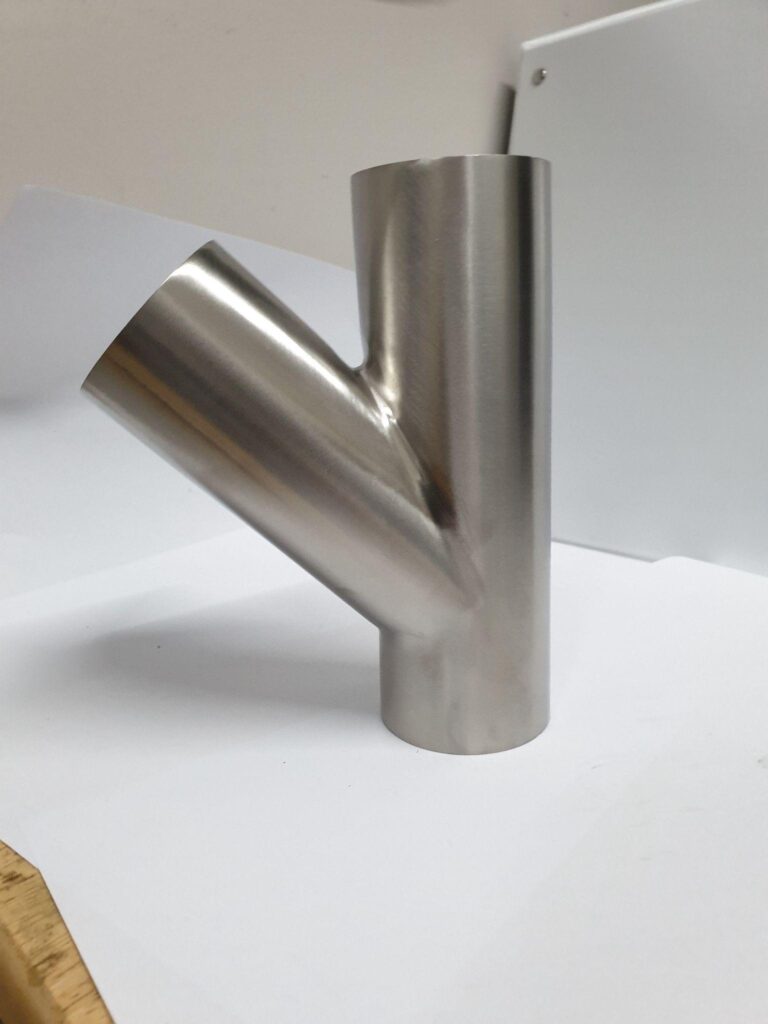
The Tube Tee 45 Degree is a stainless steel tube fitting that creates a branch connection at a 45-degree angle to the main tube run, rather than the perpendicular 90-degree angle of a standard tee. As clearly shown in the image, where the fitting is photographed from above, giving an excellent view of its geometry, the main run tube body runs vertically through the frame while the branch outlet exits diagonally at a 45-degree angle, creating the distinctive angled Y-like profile that is immediately characteristic of this fitting type. The smooth, flowing junction between the main run body and the angled branch is clearly visible, with a clean, satin-finished exterior and a consistent wall profile throughout the fitting body.
Supplied with a 1.6mm wall in Satin Finish and available exclusively in Grade 316 stainless steel, the range covers equal tube outside diameter sizes of 12.7mm, 19.05mm, 25.4mm, 31.75mm, 38.1mm, 50.8mm, 63.5mm, 76.2mm, and 101.6mm, spanning the standard range of tube diameters most commonly used in process, hygienic, and architectural tube installations.
The 45-degree branch angle produces a markedly smoother, lower-turbulence flow transition at the branch junction compared to the sharp right-angle entry of a standard 90-degree tee. By guiding flow into or out of the branch at a more gradual, streamlined angle, the 45-degree tee reduces localised pressure drop and flow resistance at the junction, making it the preferred choice in systems handling viscous fluids, high-velocity flows, or shear-sensitive products where a sharp directional change at the branch point would cause unacceptable energy loss or product damage.
The satin finish is compatible with CIP and SIP cleaning procedures, and Grade 316 stainless steel enhanced with molybdenum provides superior resistance to chloride corrosion, making this fitting well-suited to food processing, dairy, pharmaceutical, and marine tube system applications where both hygienic surface quality and long-term material performance are essential.